Music bed
Welcome to another turn of The Sonic Wheel
I’m Christopher Howell
Music bed down
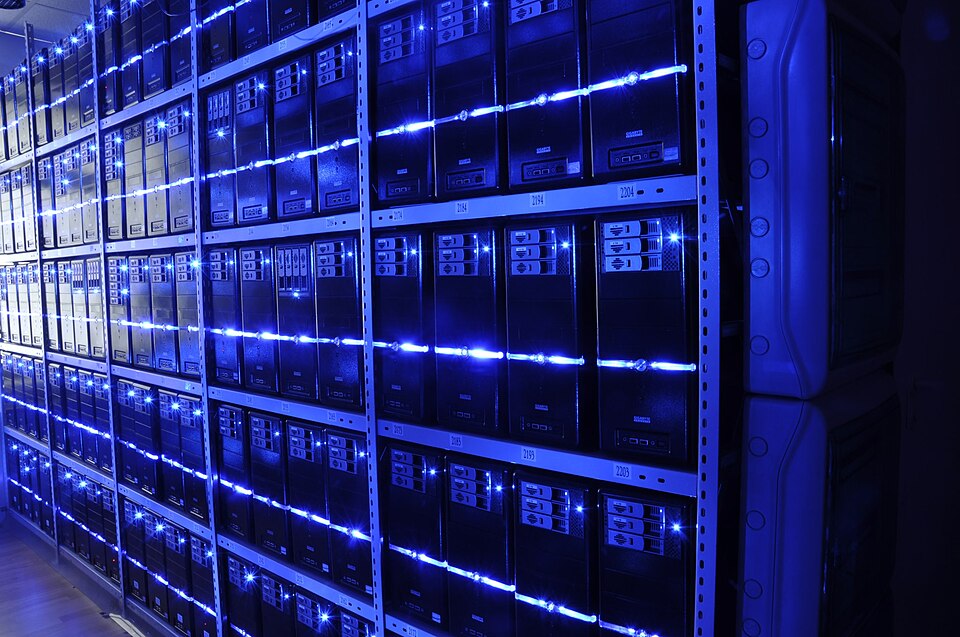
Data centers have stirred a lot of discussion and controversy lately. Let’s take a look at the science behind the controversy. A data center is collection of servers located in one building. A server is a computer, not too different then a desktop computer you might have at home or at work. It runs a set of software to perform different jobs. A web server serves you web pages you ask for. A mail server shows you what’s in your email inbox. As you know, a computer uses electricity and generates heat.
Enterprise data centers tend to be smaller. A bank might have a data center in the basement. You use it when you do online banking. Edge data centers are placed closer to it’s users to provide quick service. Netflix needs edge data centers to quickly provide movies on demand. Co-location data centers have a mix of different servers and clients all doing different work. My website is in a co-location web data center.
Hyperscale data centers are the largest. They are in huge warehouse-like buildings of 100 thousand square feet or more covering acres of land. They contain thousands of servers and use electric power exceeding 100 megawatts. Hyperscale data centers can use more electricity then small cities and demand millions of gallons of water a day for cooling. The massive electric and water use have an environmental impact. After they’re up and running they require a small number of workers so there seems to be no long term employment advantage for the community. The recent growth of these hyperscale data centers is fueled by the boom in Artificial Intelligence or AI by companies like Meta, Amazon, Google, OpenAI and Anthropic.
Hyperscale data centers have a big impact on local power grids and electricity prices. Boston University electrical and computer engineering professor Ayse Coskun (eye-zea jush-kun) researches data center power management and data center power grid interactions. Professor Jush-kun (Coskun) says new electrical infrastructure costs money and who pays could effect your electric bill.
(cut 1)
So when a hyperscale data center connects to the grid, utilities may need new substations, new infrastructure, transmission lines that deliver the power may require upgrades. Interconnection studies of these data centers could take years potentially, and our electrical grid originally was not designed for rapid additions of single customers at this scale. So typically, if 100 megawatt, 200 megawatts of power is coming up, it comes at various locations in a city, not all in one location. So that’s the big difference.
On electricity prices, the impact of a data center being built depends on several factors. Who pays for the infrastructure upgrades? How constrained the local power grid already is and whether the data center operates in the traditional more rigid form or is it adopting any flexibility measures by shifting or reducing its power when needed. If upgrade costs are shared broadly across all the ratepayers, then residential customers may see higher bills and we saw some examples of this in the recent years. If developers cover most of the infrastructure costs and facility also operates flexibly, meaning, again, it can change its power during high demand periods and the like, then the pricing impact can be more limited. There are also reliabilty implications potentially. Large facilities can increase the peak demand stress on the grid and it can increase congestion in an already constrained area of the power grid. So this is one option, but they can also become part of a better and more resilient solution.
For instance, in data centers, there’s a lot of discussion in various power grid regions in the U.S. If data centers are designed as flexible loads, meaning they can temporarily reduce or shift their electric use during grid stress times, then they can support more stability. They can help avoid rapid infrastructure upgrades, and these upgrades can be planned and done over a longer period of time, they can also help with more renewable energy integration, which also takes time.
That was Boston University professor (eye-zea jush-kun) Ayse Coskun. Professor Coskun says greenhouse gas emissions from a data center depends on how local energy is generated.
(Cut 2 )
So electricity itself is not inherently clean or dirty. It depends on how it is generated. If a data center operates in a region heavily dependent on coal or natural gas, then higher electricity demand can increase fossil fuel generation and emissions as a consequence. If the data center is in a region with abundant wind, solar, hydro, nuclear power, then the emissions impact might be much lower. Timing also matters. It’s not the generation, but also the timing of the generation and the usage of electricity. So many companies, many tech companies, for instance, purchase renewable energy credits or sign long term power purchase agreements with wind or solar firms, and that helps on an annual accounting basis of that company. But the specific climate impact depends on when the electricity is consumed. For example, if AI workloads at a data center are running at times when fossil generation dominates, such as in the evenings, even if that company buys renewables elsewhere, emissions of that region can still be high. This is why there’s growing discussion around doing computing in a carbon aware way or matching electricity use to renewable availability for data centers. Renewables absolutely have some place in this conversation, but integration is key. Renewable energy is variable, solar, wind, they change on a daily or seasonal basis. So AI data centers can actually help by shifting workloads to times of high renewable generation by using energy storage and coordinating with grid operators as opposed to just being a passive rigid consumer. So without improvements in efficiency, flexibility, and clean energy integration, then rapid AI growth could increase regional emissions. But with the right policies and design choices, data centers can also accelerate renewable deployment and help modernize the grid. AI growth and climate policy are now in a way interconnected. How we design these facilities today will influence emission trajectories for possibly four decades.
That was Boston University professor (eye-zea jush-kun) Ayse Coskun.
University of California Professor Shaolei Ren (shaow-lay ren) researches data center energy management, power systems, and the community impacts of data centers. Hyperscale data centers can use millions of gallons of water a day, much of that for cooling. Professor Ren says data center water usage varies. They could use a lot of water during the summer but less during the rest of the year.
(Cut 3)
So I think for the communities or individual towns, the most important metrics is the direct water usage. And if you look at some data center systems, they may not use a lot of water. Their total annual water usage number could be pretty low. The most important metric that is not disclosed in those annual number is the peak water demand. Just like when we design the power grid, we have to make sure at anytime during the summer or the winter storm, the power grid is able to supply the electricity to all the demand, but water is the same. Water system has to be designed to meet all the water demand during the summertime and also at all pressure zones.
And in many communities, the public water system do not have the available capacity to accommodate the new industry scale demand from data centers. So some data center, they could be using very low annual amount of water, but their water usage is concentrated around a couple of weeks a year. And that means during the summertime, they’re using really high amount of water and in the order of like million gallons per day, and they don’t use water for the rest of the year. So that’s why you see a really low number, which is really misleading and misinforming the public discussion.
So these millions of gallons of water capacity requests from the local water infrastructure is really straining the system. And in many cases, the communities don’t have that much water available to support the demand.
That was University of California Professor (shaow-lay ren) Shaolei Ren. Hyperscale data centers require a lot of energy. Some are constructing their own electrical generation plants on site. They also require backup diesel-powered generators. This contributes to unhealthy emissions. Professor Ren says a study revealed that the heath impact of those emissions could run between 10 to 20 billion dollars.
(Cut 4)
And these generators are mostly powered by diesel, and this can pollute the air releasing large amount of nitrogen oxides, PM 2.5, those are fine particles that can penetrate deeply into people’s lungs and create immediate health outcomes like asthma, a heart attack, even premature death.
So we did some study using the EPA’s modeling tool, showing that as of the end of 2024, if these generators release just 10% of the permitted amount, the total annual health impact is roughly 200 to $300 per year. And nowadays we’re seeing a lot more diesel generators installed. So the health outcome could be much higher than our earlier estimate. And this is just a direct impact. And data center are also using electricity, and some of the electricity grid is not that clean. They’re releasing carbon, but they are also releasing air pollutants like those PM 2.5 or nitrogen oxides.
In the U.S., despite years of progress, the power plants is still a leading source of air pollutants, and this can harm people’s health, especially for the communities living next to those power plants. And the elevated health risk of living next to some power plants is very well documented. And also these air polluters are not just limited by the county line. They can travel hundreds of miles along with the wind. So overall, we had a study to show that in 2028, the US data center health impact in total, including the backup generators and also the electricity usage, it could be roughly $10-20 billion. At the national level, it’s probably modest. It’s not that high, but most of the impact is concentrated around those communities living next to data centers or living next to power plants. Nowadays, we’re seeing a lot of data centers are building their own power plants outside. So essentially, this is turning the data center campus into a power plant. In most cases just fossil fuel power plants.
That was University of California Professor (shaow-lay ren) Shaolei Ren.
The controversy over data centers could be all for nothing. The guy doing the smartest reporting on data center financing is EZ Primary Research CEO Ed Zitron. He argues data center financing is built on a house of cards. It’s costing trillions of dollars to build data centers. They may never be able to pay those loans. By 2030 many data centers won’t get built and the shell companies financing them will be bankrupt. The dollar figures are so large that the resulting economic collapse will probably dwarf the 2008 recession. AI is the only product that costs more to produce then customers will pay and the more customers use it, the more it costs to produce.
Journalist and writer Cory Doctorow reminds us that we still don’t know if AI can do what it’s boosters say it can do, Quote - Unless there’s some way to estimate how much money we have to give to AI companies before they cure cancer, we should at least consider the possibility that the true sum is “more money than exists now and that will ever exist.” We should also consider that whatever benefits to cancer research that AI might deliver could come with a higher price-tag than the promising cancer research we’re dropping because we can’t find far more modest sums. – end quote.
To learn more about data center financing search for Ed Zitron on YouTube.
Music bed up
That’s it for this spin of The Sonic Wheel
Thanks for listening.
I’m Christopher Howell
Music bed down
Credits
Music by Radio Direct
Logo by Snehanshu Dharmadhikari on Unsplash
Thanks to SciLine, a non-profit based at the American Association for the advancement of Science for production assistance. Learn more at https://www.sciline.org/about/
https://bookshop.org/p/books/the-reverse-centaur-s-guide-to-life-after-ai-how-to-think-about-artificial-intelligence-before-it-s-too-late-cory-doctorow/ac86987834ee96c2
https://pluralistic.net/2025/12/05/pop-that-bubble/#u-washingtonhere -
https://www.wheresyoured.at/the-subprime-data-center-crisis/
BalticServers.com, CC BY-SA 3.0 https://creativecommons.org/licenses/by-sa/3.0, via Wikimedia Commons